Saturday, June 20, 2015

Greece on the Precipice


By George F. Will 


Now come Greeks bearing the gift of confirmation that Margaret Thatcher was right about socialist governments: “They always run out of other people’s money.” Greece, from whose ancient playwrights Western drama descends, is in an absurdist melodrama about securing yet another cash infusion from international creditors. This would add another boulder to a mountain of debt almost twice the size of Greece’s gross domestic product. This protracted dispute will result in desirable carnage if Greece defaults, thereby becoming a constructively frightening example to all democracies doling out unsustainable, growth-suppressing entitlements.
In January, Greek voters gave power to the left-wing Syriza party, one third of which, the Economist reports, consists of “Maoists, Marxists and supporters of Che Guevara.” Prime Minister Alexis Tsipras, 40, a retired student radical, immediately denounced a European Union declaration criticizing Russia’s dismemberment of Ukraine. He chose only one cabinet member with prior government experience — a former leader of Greece’s Stalinist Communist Party. Tsipras’s minister for culture and education says Greek education “should not be governed by the principle of excellence ... it is a warped ambition.” Practicing what he preaches, he proposes abolishing university entrance exams.
Voters chose Syriza because it promised to reverse reforms, particularly of pensions and labor laws, demanded by creditors, and to resist new demands for rationality. Tsipras immediately vowed to rehire 12,000 government employees. His shrillness increasing as his options contract, he says the European Union, the European Central Bank and the International Monetary Fund are trying to “humiliate” Greece.
How could one humiliate a nation that chooses governments committed to Rumpelstiltskin economics, the belief that the straw of government largesse can be spun into the gold of national wealth? Tsipras’s approach to mollifying those who hold his nation’s fate in their hands is to say they must respect his “mandate” to resist them. He thinks Greek voters, by making delusional promises to themselves, obligate other European taxpayers to fund them. Tsipras, who says the creditors are “pillaging” Greece, is trying to pillage his local governments, which are resisting his extralegal demands that they send him their cash reserves.
Yanis Varoufakis, Greece’s finance minister, is an academic admirer of Nobel laureate John Nash, the Princeton genius depicted in the movie “A Beautiful Mind,” who recently died. Varoufakis is interested in Nash’s work on game theory, especially the theory of cooperative games in which two or more participants aim for a resolution better for all than would result absent cooperation. Varoufakis’s idea of cooperation is to accuse the creditors whose money Greece has been living on of “fiscal waterboarding.” Tsipras tells Greece’s creditors to read “For Whom the Bell Tolls,” Ernest Hemingway’s novel of the Spanish Civil War. His passive-aggressive message? “Play nicely or we will kill ourselves.”
 Since joining the euro zone in 2001, Greece has borrowed a sum 1.7 times its 2013 GDP. Its 25 percent unemployment (50 percent among young workers) results from a 25 percent shrinkage of GDP. It is a mendicant reduced to hoping to “extend and pretend” forever. But extending the bailout and pretending that creditors will someday be paid encourages other European socialists to contemplate shedding debts — other people’s money that is no longer fun.
Greece, with just 11 million people and 2 percent of the euro zone’s GDP, is unlikely to cause a contagion by leaving the zone. If it also leaves the misbegotten European Union, this evidence of the E.U.’s mutability might encourage Britain’s “euro-skeptics” when, later this year, that nation has a referendum on reclaiming national sovereignty by withdrawing from the E.U. If Greece so cherishes its sovereignty that it bristles at conditions imposed by creditors, why is it in the E.U., the perverse point of which is to “pool” nations’ sovereignties in order to dilute national consciousness?
The E.U. has a flag no one salutes, an anthem no one sings, a president no one can name, a parliament whose powers subtract from those of national legislatures, a bureaucracy no one admires or controls and rules of fiscal rectitude that no member is penalized for ignoring. It does, however, have in Greece a member whose difficulties are wonderfully didactic.
It cannot be said too often: There cannot be too many socialist smashups. The best of these punish reckless creditors whose lending enables socialists to live, for a while, off of other people’s money. The world, which owes much to ancient Athens’ legacy, including the idea of democracy, is indebted to today’s Athens for the reminder that reality does not respect a democracy’s delusions.

Monday, June 15, 2015

A “LOW BLOW” AGAINST DISSIDENTS: SUPPORTING DEMOCRACY WORLDWIDE

BY Alexander Podrabinek
0
First of all, I would like to thank you for this day that proves that the interests of freedom are not limited by national borders. This is extremely important for the people your Foundation is concerned with. Allow me to assume that the word “victim” embraces all people who experience oppression from communist despotism.
When communist regimes collapsed in Eastern Europe at the end of the last century, all people shared in the euphoria of the victory. And how could people not rejoice, especially those who had been liberated from communist oppression? Yet, communism turned out to be durable and adopted many faces. Communist dogmatism and classic communist dictatorship gave place to communist pragmatism and modified communism.
It acquires a bit of market economy, a touch of democratic rhetoric, and erects structures that imitate democracy—from parliament and court system to pluralism of political parties to media. It could be taken for a particular or unique national democracy, and only from the inside is it clear that it’s just the same old despotism, a bit modernized and in a new disguise.
Like influenza after each epidemic, modifying and surviving by adjusting to new circumstances, communism after each defeat modifies itself in order to survive in the contemporary world. But its essence does not change. The true core of communist states lays in preserving despotic rule and finding a safe niche in the international community.
These dictatorships often look for international recognition.
Today their goal is to secure a legitimate spot within the family of civilized states. They want to equalize freedom and slavery, democracy and dictatorship. Like a sinking man looks for a lifesaving vest, dictatorships desperately cling onto national sovereignty, membership in esteemed international organizations, and an atmosphere of politeness and friendliness as the last signs of legitimacy.
I will tell you frankly: when representatives of great democracies – American or French, for instance – shake hands with the Cuban dictator, it signifies a gesture of politeness and diplomatic protocol usually only reserved for the West. For dictators it becomes a proof of recognition and acceptance of their right to oppress their own people. They replicate these handshakes as evidence of their victory and as a message to anticommunist resistance that the world has betrayed them and that their cause is hopeless.
For those who oppose communist regimes, sometimes within a small group, at times just on their own, it is a low blow. It demonstrates that today great democracies value mutual understanding with dictatorships more than freedom and human rights.
I know that this is not fully accurate. There are people in North America and Western Europe who more highly value freedom and dignity than politicians who crave mutual understanding with communist dictatorships. There are more people who put freedom before economic or political gains, who do not distinguish between their personal freedom and freedom for the whole of humanity. I know that there are many dignified people in democratic countries and that their voice is pretty strong.
But it is not easy to hear this voice on the other side of a barbed wire. In closed states, the state propaganda invests huge efforts into convincing people that the entire civilized world is ready to accept contemporary communism or its modifications; that democracies are ready to make peace with dictatorships.
The governments of dictatorships talk endlessly about peace, but they are always ready for a war. And they demand worldwide recognition demonstrating their readiness to go into war. They blackmail the international community by building up nuclear weapons or by their readiness to annex neighboring territories. Dictatorships talk about peace while practicing belligerence, all for the sake of persuading Western powers to work with them.
I would like to remind you of the words of our great Russian compatriot Alexander Solzhenitsyn who said that the antithesis to peace is not a war; the antithesis to peace is violence and oppression. The absence of military actions is not yet peace. In dictatorships, the war is going on; it is not very visible from outside, but it has its casualties, with destruction of entire infrastructure that demoralizes the entire community and degrades the legal system.
I take part in such a war, and I can say that the solidarity of the free world with those who fight for their freedom in dictatorships is extremely important. Of course, the one who rises to fight against despotism will continue his struggle even if there is no support at all. But solidarity with the world makes him ten times stronger. This solidarity shows that the aspiration for freedom is not a capricious act of whimsy for loners, but a universal value that promotes human societies from barbarism to a state of progress.
It is a hard path; it has numerous losses along it. I am grateful that you treat our losses as your own. I am happy that the notion of freedom inspires not only those who are on the verge of life and death in prisons and concentration camps, but also those who enjoy all privileges of democracy.
Today I share your award with those of my friends who did not survive to see the collapse of communism in our country. And even more with those who are alive and keep fighting for our mutual freedom. With those who are imprisoned in China, Cuba, North Korea, Belorussia, Azerbaijan, Uzbekistan, Russia, Iran and other states with despotic regimes. I want them to know – this medal belongs to them, as well. Thank you.

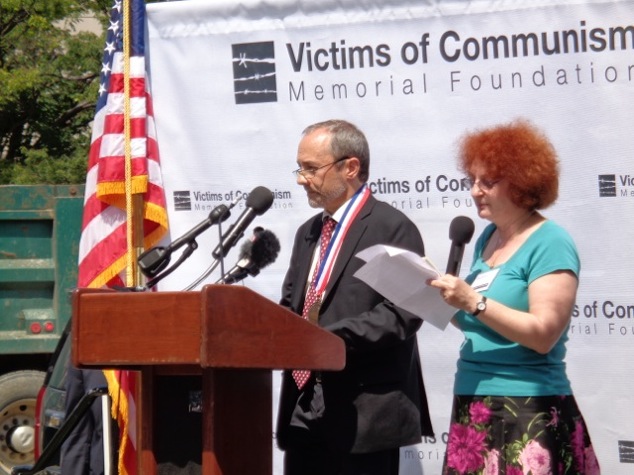
These remarks were delivered at the annual Victims of Communism Commemoration in Washington, D.C., on June 12

Friday, May 29, 2015

Humans…(you cannot kill the fire)

By Lluka Qafoku                     

We are humans
It is a magic word, like every word
We, humans, got name and fame through them, standing Time
We spread our humane humus and waste as far as we go in Universe
We try to domesticate all as subjects to our Will though we never have known whence it comes..
We got homes out of Nature, ever-lit homes, air-conditioned homes, all provided homes
Lukewarm well balanced homes, “reasonably” safe homes
To fly from natural mercilessness of natural law
Into what we ingeniously stole away from nature and claim “our creation”
What is in fact a denatured domestication
And wishful illusion of free will and property

We keep reinventing our homes, we make them drive, sail and fly
We keep domesticating all our environmental surroundings,
Trying to walk on the dangerous razor-edge of our science
Between destruction and construction, economy and ecology
And first and last we have domesticated nearly all natural fire,
Now including solar fire, standing on the brink of atomic apocalypse
We, the animals seemingly capable of all life destruction

Our intimate, comfortable homes
We have succeeded to build to save our crippled, homogenous freedom
To outlive and survive
Natural selection
Preserving the unfit and perverse and deeming it the life sense
Until all sense we lost

Our domesticating, moderating, artificial power seemingly superficial and fake gave us all humanity
We, the last dead end of the Tree of Life, of Biosphere
That insignificant “poor player that frets his hour upon stage and then is heard no more” (Shak)
Ridiculous enough to challenge all World order and chaos

However
We humans keep knocking since birth on the door
Of some natural Grace
Of a future that cannot become a past Trace
In our casual and rarely met but constant in time
Promethean rush of sublime creative effort
Towards a Promised cosmic humane wide open

Home….

Tuesday, May 19, 2015

Polemic against Biberism (Mr. Biberaj)


By Vasel Malaj

Mr. Biberaj! Your lecture on democracy was delivered too late. On Facebook, I have personally criticized Albanian politicians for being responsible for the present state of Albania. After my criticisms, we exchanged a short message, and then you immediately unfriended me.

Mr. Biberaj, you are the one who opened the door to the Voice of America for the former propaganda journalists of Albanian Communist Radio-Television. They, along with their families, served as levers of the Communist Dictatorship.

To what end? Only time will tell.

The plain truth is that the Voice of America’s broadcasting has entirely changed course after the arrival of the Communist dictatorship’s journalists. It has become a stage for the promulgation of the Communist regime’s intellectuals and pseudo-intellectual spies, who purposely are sent to the West on a special mission: to control the Albanian diaspora communities.  

If we were to compare your lecture today with the book you previously wrote, “Albania in transition,” we would see you contradict yourself, for you willingly or unwillingly become a guardian and inspirer of the Albanian Communist mafia and its cupola of crime. For this reason, you solely confirm the accuracy of my comments on and criticisms of the Albanian-Communist mafia. I have posted these comments and criticisms on the “Voice of America” website and the social network Facebook, and you unduly rejected all of them.  

The Albanian Communist mafia’s plot against the respectable journalists of the Voice of America, Isabela Çoçoli and Zamira Edwards, clearly demonstrates the fact that the Communist mafia continues to fight us even here in this great democratic country, the United States. Your analysis bears no value today, since we, the former politically persecuted people by the Communist regime, have spoken out for years what you were forced to say today.

I feel good about one thing: the Communist propaganda colleagues have at last taught you to ceremoniously voice yourself as “politically correct.”


Friday, January 2, 2015

Amnesia


By Grigor Nosi


I would not choose to write on dark, communist, times, as long as the architects of the Red Holocaust are not yet punished. Moreover, they arrogantly run the country’s politics today. But, as I was reading an article on the life of dissident Klement Islami, the lamenting voice of a young lady from Durres came from deep inside my soul and woke me up from this mindset. She was pleading, “Doctor, will you have to amputate my leg? Please doctor, heal me! I am still young!”  

It was 1977, and I was assigned to work at the General Surgery Hospital in Elbasan, Albania as a medical practitioner. The hospital was recently built, and it neighbored the Elbasan Psychiatric Hospital. A shallow ditch and a partially collapsed fence divided the two, huge, buildings. People spoke of the hospital with a secretive undertone and referred to it as a place of isolation for selected individuals, enemies of the regime. The word was out that the State Security had cherry-picked doctors to intentionally abuse the patients who were incarcerated in that Hell against their will.

“What is your name?” I asked the young lady who was uncontrollably crying in pain. In a broken voice, she somberly said, “Zana, Zana Dhroso.” “Stretch out your leg,” I told her, and I began to probe her red, swollen, and infected knee. Each time I touched it, she bit her lips, dry and split down the middle due to the various medications she was taking. “Stay strong,” I said. After I injected a local anesthesia, I opened the wound and pressed gauze onto it to drain the massive infection, which had spread all over her knee. Just as I finished cleaning the huge wound, a weak voice pleaded, “Doctor, are you going to amputate my leg? Please, do not cut it off! I am young! It’s the second time I have had abscessed wounds.” “No,” I told her. “Your leg will heal.” Her fragile, long, elegant, fingers tightened around my hands as a sign of gratitude.

The senior doctors knew what caused those huge abscessed wounds. I heard that patients brought to the hospital on court order, were injected with pine resin. The injection aimed to paralyze them and ensure they were unable to flee from the prison hospital. I had not previously received the chance to see a case up close or to treat it. I was then, deeply troubled, and I told my father Doctor Stiliano Nosi. He sadly confirmed the practice. He was also an acquaintance of Zana’s father, Doctor Dhroso. My father advised me to especially care for her, and I did. I treated her even after she was sent back to the Psychiatric Hospital.

One day on my hospital rounds, I crossed the path separating the two hospitals, and I saw Zana and her father sitting on the only bench facing the street. Doctor Dhroso, a nobleman worn down by age and agony for his daughter, addressed me in a soft, pleading voice. He showered me with blessings to show his gratitude for his daughter’s medical treatment. His eyes frequently welled up while he patted Zana’s hands that were shaking uncontrollably. Moved by the image the two, poor creatures left on me, I searched to find out why the young lady from Durres was incarcerated in a psychiatric hospital.

***
At a high school in the city of Durres, a brave act occurred that was never heard before. A female student took down the portrait of the monstrous, communist, dictator Enver Hoxha, and she threw it onto the cement floor. The picture broke into pieces in front of all students. The heroic, young, lady, forgotten by the Post-Communist era, was Zana Dhroso.

Translated from The Albanian by Hilda Xhepa

Edited by Rebekah Roberts