Saturday, August 22, 2015

The Editor-in-chief

by Visar Zhiti

(Excerpt from the book “Trails of Hell,” pg. 60)

A long time ago, in the former life when I lived above ground, I took my book with stories - like a different kind of tales, for those who grow, for an ageless reader, to the publishing house, more or less something like that.
Young Shehu, as they called Bashkim*, since the weirdo Lasgush* once had called him so - ah Lasgush’s verse, “I speak to you with fire…with fire…in my bosom I have dug a grave …” as well as in mine too, asked to become the editor of my story tales.
In fact, it was me who asked him to, and he responded “fine.” I was delighted, meanwhile, I thought: the son of the Prime Minister, Enver Hoxha’s closest collaborator, no one would dare to contest him. But no, it was not so. When the editor-in-chief of that section took Bashkim aside and explained something in confidence, I sighed, “ah.”
“I’m sorry” Bashkim said, “They don’t want to. They are saying something like following the Fourth Plenum, the outside editors are not accepted. Would you like to give me the manuscript as a gift? With your autograph.” He confused me. It was my first and only autograph.  
While I was having coffee in the club near the publishing house with the tall and slender editor-in-chief, wearing a red turtle neck, with his teeth sticking out strikingly, he spoke only about Bashkim, how he had got to know him at the Elbasan Metallurgical Plant when the editor-in-chief was doing the communist Party internship in order to become a full party member…
“Bashkim...? No. Me…” -and the editor-in-chief turned red, finally remembering to give an explanation for the book I had submitted.
“It can’t be published, consider it a beautiful prelude… It is equivocal. It is not for children or adults; it’s in-between…it’s arduous. No…publish the poems first… Look! Here comes Bashkim...”
When we parted, Bashkim felt embarrassed.
“We had really gotten to know each other in Elbasan,” he said. “I was at the Metallurgical Plant doing the productive labor, that’s what they call it, the year after high school.”   
“Who was he?” I asked.  
“You didn’t know him? Fatos Kongoli*.”

* Bashkim Shehu was the son of the communist Prime Minister Mehmet Shehu.
* Lasgush Poradeci was an Albanian poet and writer.
*Fatos Kongoli has become one of the most convincing representatives of contemporary Albanian prose.

Translated from the Albanian by Hilda Xhepa


Saturday, August 15, 2015

A State Rape

By Visar Zhiti

(Excerpt from the book “Torn Hell” pg. 407)


         During the very last inspection on a gloomy day - the sun had not appeared at all as if it was out on sick leave, a photograph had fallen from a prisoner amidst the crowd near a heap of thrown-out trash.
          “What’s that? Bring it here!” The operative had barked. “What about this woman?”
            “Mine,” the prisoner had said.
          “Ah, she is beautiful, curvy, doesn’t look like she’s from the village,” the operative had licked his lips. The bloodhound. “Does she come to meet you? Hasn’t she divorced you, huh? It won’t be long till you hear words of her betraying you.”
          The prisoner froze.
          “Go now,” the operative ordered. “Leave the photograph with me.”
          “Never!” The prisoner wanted to strangle the whoremonger with his bear hands.
The inside guard pushed him away. One of the prisoner’s feet sank in the shallow water of a nearby puddle.
            After some time, when his brothers came to see him in prison in a low voice they said that his wife... the state security people hounded her… it was better not to think about her, forget her. “But this is a state rape!” The prisoner screamed.

            Luan Burimi, himself, told me this in despair, and in blighted hope said, “God’s will it isn’t true!”

Translated from the Albanian by Hilda Xhepa

Thursday, July 23, 2015

American flag flies in US Capitol Hill


By Kastriot Myftaraj

Enlightening the art of diplomacy to grown-up Besiana


Ismail Kadare is among the Communist hyenas.

I wouldn’t have a grudge against the appointment of Besiana Kadare, the daughter of Ismail Kadare, to the post of the Albanian Ambassador to UNESCO (United Nations Educational Scientific, and Cultural Organization), with its HQs in Paris, who until now has carried the duties of UNESCO’s charge d’affaires in the Albanian Embassy in France, if it did not ring in my ears the poem of Ismail Kadare, “Enlightening the books to little Besiana,” published first on “November” magazine, in early 70’s, and later in his book of poems, titled “The Time,” published in 1976. In this poem, Ismail Kadare reveals the conversation at his home library with Besiana, the recent appointed Ambassador. Ismail Kadare writes in the poem:

“Yet you insist, however, something has got to be torn,
Indeed, every library has something to be torn into pieces,
Here at the nook lie locked some hermetic poets,
Seems fair, somehow, you deal with them,
As time goes by, you learn new words and flourish, 
They do quite the opposite by forgetting words,
Your age, for now, allows you to cope with these poets,                 
I step aside,                 
And you act!”  

Hermetic poetry is a form of western poetry in the 20th century, which originated in the 19th-century from French symbolism. Some of the greatest poets of the 20th century belong to this hermetic poetry. It is extremely horrific that a poet like Ismail Kadare is suggesting to his child to tear the books of other poets into pieces. This is a twofold crime, an assassination of art and poetry by Ismail Kadare through the misuse of a child, and the cultivation of the barbaric acts within the child- the act of tearing books.
I often recall listening to the poem recited on radio and television during the Communist dictatorship era. Moreover, at concerts organized by the school, the superiors would often appoint a student to recite this poem. It’s clear: communist dictatorship propaganda cared more about this poem for some reasons that I will further explain. Communist dictator Enver Hoxha banned books during his rule and publicly denounced Albanian and foreign writers and poets as well as their books. But Enver Hoxha never spoke of tearing, or burning books- at least not publicly.
The dictator knew that the West would tend to describe the wilderness of his barbaric dictatorship with the Ottoman heritage environment where Enver Hoxha was born and raised, consequently the whole country as well, so he tried to create the impression to the foreign visitors as a man being polished by the best western culture. Therefore, paradoxically, it served at Enver Hoxha’s convenience that the number one courtier poet and writer, Ismail Kadare truly was, has written a poem in which he calls for tearing books. Practically Enver Hoxha would say to the Albanian people and the whole world; you must first look to what the greatest intellectual of the country wants from me, to tear books; thenceforth you come and blame me for what I’m doing! When the greatest intellectual of the country boasts himself of asking his daughter to tear the books of western poets, it means that he requests from me, the leader of the country, to arrange burning books on the street plazas! You know, when the state burns and tears books, subsequently it increases the number of heads to be executed, so you understand, my prominent writer and poet is demanding I should cut more heads!
Relevantly, it was Enver Hoxha’s calculus. Unquestionably, Enver Hoxha ordered his propaganda machine to repeat frequently to Albanian people the Kadare book-tearing poem, however he did not organize laceration and books burning. Enver Hoxha did not ask Ismail Kadare to write a poem of tearing western books. Ismail Kadare wrote it in his zeal to distinguish himself as the guardian of the communist dictatorship. Kadare suitably played the character of a Pol Pot in a Stalinist regime. Enver was a Stalinist, but not a Pol Pot. At that time, the tearing and the burning of books was publicly done by the Pol Pot regime in Cambodia. Besiana of the poem, whom once was advised by her father to tear the books of the hermetic poets, today has become the Albanian ambassador to an international organization, which contains the preservation and development of the world culture at the core of its mission, includes safeguarding of books. Accordingly, she has become a cultural diplomat. If we would paraphrase the title of her father’s poem, it is “the time” to give a  "cultural enlightenment on diplomacy to a grown up Besiana?"
Now, is it proper for Albania to appoint ambassador to UNESCO precisely the person, whose name became synonymous with the anticultural phenomena of book tearing? Don’t we have the right to ask for reassurances from the Albanian government that Besiana has abandoned the book-tearing practice? To be at peace, should Besiana, at least today, say sorry for the poem for which she once felt proud of? Shouldn’t Ismail Kadare apologize for the poem at least now that his daughter has become ambassador to UNESCO? It is clear to all that Ms. Kadare was appointed to that position merely because she is the daughter of Ismail Kadare.
A French poet Isidore Duccase, Count of Lautreamont (1846-1870), who had a great influence on hermetic poetry as well as on the predecessors of the French Symbolism, said: "The water of a whole sea wouldn’t be enough to wash up a drop of an intellectual blood.”


Vilson Blloshmi and Genc Leka were hermetic poets 
executed by the communist fire squad in 1977, in Albania.


By setting his little daughter to rip up the books of other poets, Ismail Kadare has triggered intellectual bloodshed. For that, the whole "sea water" of the laudatory hymns of his local and foreign aficionados is not enough to wash this crime of his. Her Excellency Ambassador Besiana Kadare goes to UNESCO holding the record of a person who in her childhood is misused in committing a crime. I think Besiana Kadare doesn’t have to agonize from this; she doesn’t deserve to suffer from it. Therefore she should speak out about this episode in relations with her father like Stalin’s daughter, Svetlana, spoke out about her father.
Ambassador Besiana Kadare should address her father with an open letter where she rebukes his misuse of her by putting her to tear the books of other poets. Matured Besiana needs to do this publicly, for she has been made widely known for tearing books, thanks to her celebrated father. Ismail Kadare must then respond to his daughter with another poem: “Apologizing to Besiana for pushing her to tear books in her childhood." Ismail Kadare of course should seek forgiveness from all of us who were mentally violated by his poem when we were school students.
It is not accidental that Ismail Kadare wrote the poem “Enlightening the books to little Besiana,” just when he was dying as a poet. His book of poetry "The Time," published in 1976 was virtually his last book of poetry. Since 1976, when he published the volume of poetry "The Time," Ismail Kadare has not published any new book of poetry. The book "The sky has no shape," published in 2005, is the summary of 100 selected poems, and in it are only 33 new poems, which were not published in his previous books until 1976. In the 231-page book, these 33 poems written in the period from 1976 to 2005 occupy only 62 pages. It’s not in vain that the title of the book "The sky has no shape" is taken out of one of his poems:
  
“The sky has no shape,
Like idiot’s brain.”

Apparently, with this book, Kadare claims that after 1976, his brain was without form, in terms of poetry; it is not a poet’s brain any longer. When Kadare sensed the dying poet inside him, in an act of sadomasochism, he pushed his little girl to rip up the books of other poets.


The American flag flies in Capitol Building in honor of the communist writer Ismail Kadare 
Washington, DC 2015


Saturday, June 20, 2015

Greece on the Precipice


By George F. Will 


Now come Greeks bearing the gift of confirmation that Margaret Thatcher was right about socialist governments: “They always run out of other people’s money.” Greece, from whose ancient playwrights Western drama descends, is in an absurdist melodrama about securing yet another cash infusion from international creditors. This would add another boulder to a mountain of debt almost twice the size of Greece’s gross domestic product. This protracted dispute will result in desirable carnage if Greece defaults, thereby becoming a constructively frightening example to all democracies doling out unsustainable, growth-suppressing entitlements.
In January, Greek voters gave power to the left-wing Syriza party, one third of which, the Economist reports, consists of “Maoists, Marxists and supporters of Che Guevara.” Prime Minister Alexis Tsipras, 40, a retired student radical, immediately denounced a European Union declaration criticizing Russia’s dismemberment of Ukraine. He chose only one cabinet member with prior government experience — a former leader of Greece’s Stalinist Communist Party. Tsipras’s minister for culture and education says Greek education “should not be governed by the principle of excellence ... it is a warped ambition.” Practicing what he preaches, he proposes abolishing university entrance exams.
Voters chose Syriza because it promised to reverse reforms, particularly of pensions and labor laws, demanded by creditors, and to resist new demands for rationality. Tsipras immediately vowed to rehire 12,000 government employees. His shrillness increasing as his options contract, he says the European Union, the European Central Bank and the International Monetary Fund are trying to “humiliate” Greece.
How could one humiliate a nation that chooses governments committed to Rumpelstiltskin economics, the belief that the straw of government largesse can be spun into the gold of national wealth? Tsipras’s approach to mollifying those who hold his nation’s fate in their hands is to say they must respect his “mandate” to resist them. He thinks Greek voters, by making delusional promises to themselves, obligate other European taxpayers to fund them. Tsipras, who says the creditors are “pillaging” Greece, is trying to pillage his local governments, which are resisting his extralegal demands that they send him their cash reserves.
Yanis Varoufakis, Greece’s finance minister, is an academic admirer of Nobel laureate John Nash, the Princeton genius depicted in the movie “A Beautiful Mind,” who recently died. Varoufakis is interested in Nash’s work on game theory, especially the theory of cooperative games in which two or more participants aim for a resolution better for all than would result absent cooperation. Varoufakis’s idea of cooperation is to accuse the creditors whose money Greece has been living on of “fiscal waterboarding.” Tsipras tells Greece’s creditors to read “For Whom the Bell Tolls,” Ernest Hemingway’s novel of the Spanish Civil War. His passive-aggressive message? “Play nicely or we will kill ourselves.”
 Since joining the euro zone in 2001, Greece has borrowed a sum 1.7 times its 2013 GDP. Its 25 percent unemployment (50 percent among young workers) results from a 25 percent shrinkage of GDP. It is a mendicant reduced to hoping to “extend and pretend” forever. But extending the bailout and pretending that creditors will someday be paid encourages other European socialists to contemplate shedding debts — other people’s money that is no longer fun.
Greece, with just 11 million people and 2 percent of the euro zone’s GDP, is unlikely to cause a contagion by leaving the zone. If it also leaves the misbegotten European Union, this evidence of the E.U.’s mutability might encourage Britain’s “euro-skeptics” when, later this year, that nation has a referendum on reclaiming national sovereignty by withdrawing from the E.U. If Greece so cherishes its sovereignty that it bristles at conditions imposed by creditors, why is it in the E.U., the perverse point of which is to “pool” nations’ sovereignties in order to dilute national consciousness?
The E.U. has a flag no one salutes, an anthem no one sings, a president no one can name, a parliament whose powers subtract from those of national legislatures, a bureaucracy no one admires or controls and rules of fiscal rectitude that no member is penalized for ignoring. It does, however, have in Greece a member whose difficulties are wonderfully didactic.
It cannot be said too often: There cannot be too many socialist smashups. The best of these punish reckless creditors whose lending enables socialists to live, for a while, off of other people’s money. The world, which owes much to ancient Athens’ legacy, including the idea of democracy, is indebted to today’s Athens for the reminder that reality does not respect a democracy’s delusions.

Monday, June 15, 2015

A “LOW BLOW” AGAINST DISSIDENTS: SUPPORTING DEMOCRACY WORLDWIDE

BY Alexander Podrabinek
0
First of all, I would like to thank you for this day that proves that the interests of freedom are not limited by national borders. This is extremely important for the people your Foundation is concerned with. Allow me to assume that the word “victim” embraces all people who experience oppression from communist despotism.
When communist regimes collapsed in Eastern Europe at the end of the last century, all people shared in the euphoria of the victory. And how could people not rejoice, especially those who had been liberated from communist oppression? Yet, communism turned out to be durable and adopted many faces. Communist dogmatism and classic communist dictatorship gave place to communist pragmatism and modified communism.
It acquires a bit of market economy, a touch of democratic rhetoric, and erects structures that imitate democracy—from parliament and court system to pluralism of political parties to media. It could be taken for a particular or unique national democracy, and only from the inside is it clear that it’s just the same old despotism, a bit modernized and in a new disguise.
Like influenza after each epidemic, modifying and surviving by adjusting to new circumstances, communism after each defeat modifies itself in order to survive in the contemporary world. But its essence does not change. The true core of communist states lays in preserving despotic rule and finding a safe niche in the international community.
These dictatorships often look for international recognition.
Today their goal is to secure a legitimate spot within the family of civilized states. They want to equalize freedom and slavery, democracy and dictatorship. Like a sinking man looks for a lifesaving vest, dictatorships desperately cling onto national sovereignty, membership in esteemed international organizations, and an atmosphere of politeness and friendliness as the last signs of legitimacy.
I will tell you frankly: when representatives of great democracies – American or French, for instance – shake hands with the Cuban dictator, it signifies a gesture of politeness and diplomatic protocol usually only reserved for the West. For dictators it becomes a proof of recognition and acceptance of their right to oppress their own people. They replicate these handshakes as evidence of their victory and as a message to anticommunist resistance that the world has betrayed them and that their cause is hopeless.
For those who oppose communist regimes, sometimes within a small group, at times just on their own, it is a low blow. It demonstrates that today great democracies value mutual understanding with dictatorships more than freedom and human rights.
I know that this is not fully accurate. There are people in North America and Western Europe who more highly value freedom and dignity than politicians who crave mutual understanding with communist dictatorships. There are more people who put freedom before economic or political gains, who do not distinguish between their personal freedom and freedom for the whole of humanity. I know that there are many dignified people in democratic countries and that their voice is pretty strong.
But it is not easy to hear this voice on the other side of a barbed wire. In closed states, the state propaganda invests huge efforts into convincing people that the entire civilized world is ready to accept contemporary communism or its modifications; that democracies are ready to make peace with dictatorships.
The governments of dictatorships talk endlessly about peace, but they are always ready for a war. And they demand worldwide recognition demonstrating their readiness to go into war. They blackmail the international community by building up nuclear weapons or by their readiness to annex neighboring territories. Dictatorships talk about peace while practicing belligerence, all for the sake of persuading Western powers to work with them.
I would like to remind you of the words of our great Russian compatriot Alexander Solzhenitsyn who said that the antithesis to peace is not a war; the antithesis to peace is violence and oppression. The absence of military actions is not yet peace. In dictatorships, the war is going on; it is not very visible from outside, but it has its casualties, with destruction of entire infrastructure that demoralizes the entire community and degrades the legal system.
I take part in such a war, and I can say that the solidarity of the free world with those who fight for their freedom in dictatorships is extremely important. Of course, the one who rises to fight against despotism will continue his struggle even if there is no support at all. But solidarity with the world makes him ten times stronger. This solidarity shows that the aspiration for freedom is not a capricious act of whimsy for loners, but a universal value that promotes human societies from barbarism to a state of progress.
It is a hard path; it has numerous losses along it. I am grateful that you treat our losses as your own. I am happy that the notion of freedom inspires not only those who are on the verge of life and death in prisons and concentration camps, but also those who enjoy all privileges of democracy.
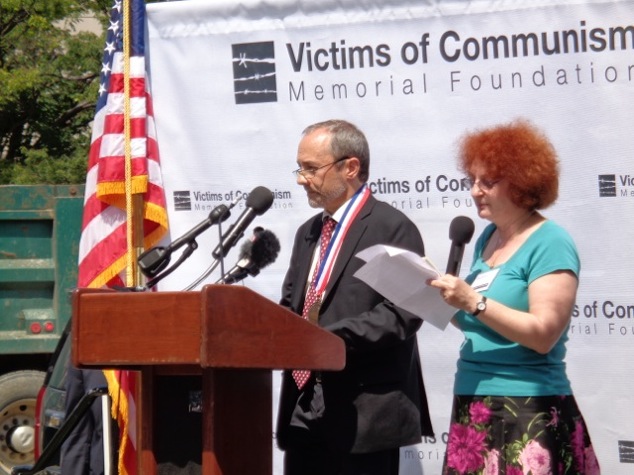
Today I share your award with those of my friends who did not survive to see the collapse of communism in our country. And even more with those who are alive and keep fighting for our mutual freedom. With those who are imprisoned in China, Cuba, North Korea, Belorussia, Azerbaijan, Uzbekistan, Russia, Iran and other states with despotic regimes. I want them to know – this medal belongs to them, as well. Thank you.

These remarks were delivered at the annual Victims of Communism Commemoration in Washington, D.C., on June 12